7 Deadly Sins Test
- 21 questions
- about 3 min
Which deadly sin are you? Rate 21 statements about ordinary habits.
Statement 1 of 21
How it works
How the 7 Deadly Sins Test is scored
-
01
21 statements, one per screen
In this 7 deadly sins test, each statement describes an ordinary habit. Rate how well it fits you, from strongly disagree to strongly agree. Your individual answers stay in this browser tab.
-
02
Three statements per tendency
Two point towards it and one points away, so agreeing does not always raise a score. Every tendency lands between 0 and 12.
-
03
The highest score is your card
Your highest tendency becomes your card. If several tie for the highest score, one of those cards is drawn at random.
FAQ
What is the 7 deadly sins test?
Wondering "which deadly sin are you"? This free 21-statement quiz compares seven everyday tendencies: pride, greed, lust, envy, gluttony, wrath and sloth. Rate each statement to see your leading tendency, all seven scores and a radar chart.
What does a high score mean?
A high score means you agreed more strongly with that tendency after reversed items were scored. Your result is the highest of your own seven scores, not a ranking against other people. Even 12 out of 12 does not mean you are worse, and a low top score still produces a result.
Is the 7 deadly sins test free?
Yes. The questions, result card, reading, radar chart, seven tendency bars and image export are free. There is no paid report to unlock and no account or email gate. After the last statement, enter a name or nickname for your card and choose Reveal my result. Share Result and Save Image do not require a purchase. A personal label is for your card; it is not a registration.
Is this quiz about the anime?
No. It is about everyday habits, not about matching you to a character from The Seven Deadly Sins. The seven tendencies come from the older tradition of the capital vices.
Do you store my answers?
Your individual answers are used for scoring in this browser tab, not sent to the scoring server or saved as an account history. Reloading clears the unfinished answers. Sharing is a separate choice: your result link includes your display name, selected card and all seven scores, and your exported image also contains personal result information. Anyone with the link or image can read it. Page delivery, fonts, visitor analytics and advertising still involve network requests; local scoring does not mean anonymous browsing.
What will I see after finishing the 7 deadly sins test?
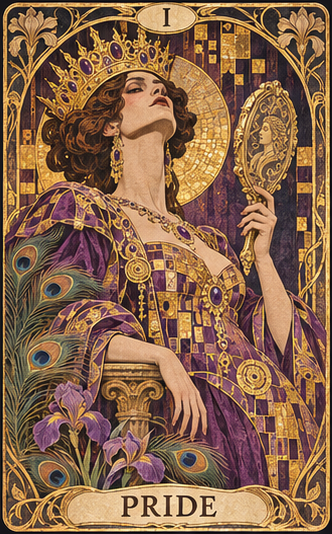
You receive one illustrated tarot card with a written reading and a counter-virtue prompt, plus a radar chart and bars for pride, greed, lust, envy, gluttony, wrath and sloth. The charts show your relative pattern; the result screen does not print numeric scores or population percentiles. This is a short entertainment profile, not a detailed psychological report. You can save the result as a PNG image or choose to share a result link.
Can I take the 7 deadly sins test on my phone without an app?
The 7 deadly sins test runs on this webpage with JavaScript enabled; no app, extension or software installation is needed. Choose one response per statement using the on-screen controls. Mobile sharing depends on your browser: where supported, Share Result opens the device share sheet and may include the PNG. Otherwise you can copy the result link or use Save Image. If a browser blocks sharing or downloads, check its permissions or take a screenshot; installing another app is not required to answer the questions.
How long does the 7 deadly sins test take, and can I retake it for free?
There are 21 statements, usually taking about three minutes; that is an estimate, not a timer or a time limit. Answer for your ordinary behaviour rather than the answer you wish were true. You may retake this free quiz without buying credits or making an account. Use Take the test at the top to start again. Save anything you want to keep first: this page does not maintain a history of earlier attempts.
Can the 7 deadly sins test read or upload files from my device?
The quiz does not ask you to select or upload a file, and its scoring does not require camera, microphone or file-system access. Save Image creates an image from the result in your browser; it does not scan your photo library. Share Result only opens a sharing flow when you choose it. These describe the current quiz features, not a guarantee about every website or browser. Ordinary page loading still sends network requests for the webpage, fonts, images and analytics.
Why does the 7 deadly sins test ask for my name, and who can see my shared result?
After the questions, a display name is required to personalise the card; a nickname works, so you do not need to enter your legal name. It is not an email address or an account. The result link puts the display name, chosen card and seven scores in the part of the URL after #. That part is not included in the initial HTTP page request, but it is readable data, not encryption: anyone holding the link, and scripts running on the page, can read it. Share only a name and result you are comfortable disclosing.
How can my friends and I compare our 7 deadly sins test results?
Send friends the same Personabay homepage and have each person complete the same 21 statements independently. Use Share Result to send your result link, or Save Image to keep and send the card with its charts. Friends can open the link to view that result, then use Take the test to make their own. Compare the shapes of the seven tendency bars as conversation starters. There is no automatic side-by-side comparison, group leaderboard or ranking against other people.
Is this 7 deadly sins test scientifically validated or religious?
No validation study or population norms are provided for this questionnaire. It is an independent entertainment quiz for self-reflection, not a diagnosis, a standardised personality assessment or a judgement of moral worth. The labels come from a religious tradition, but the questions ask about everyday habits rather than beliefs. A history source explains the labels; it does not establish the accuracy of our questions. Your result cannot establish a disorder, predict behaviour or tell you how you compare with a representative population.
How is the 7 deadly sins test scored, including ties?
Each tendency has three statements, with two scored forwards and one reversed. Responses contribute zero to four points, producing an internal total from zero to twelve per tendency. The highest total supplies the card. When several share the highest total, the current result flow randomly selects one of those tied cards; a shared result keeps that selection. All seven tendencies remain in the charts. There is no minimum qualifying score, no pass mark and no reason to treat the selected card as more precise than the underlying tied pattern.
What do lust and gluttony mean in this quiz?
Lust refers here to novelty and temptation: a new interest taking over your attention, buying impulsively, or being able to leave an interest behind. It does not assess sexual behaviour or sexual desire. Gluttony concerns continuing past satisfaction, including snacks and additional episodes, alongside a reversed statement about stopping. These are definitions for this questionnaire. A card with one of these names should not be read as a judgement about your relationships, diet or health.
Where the 7 deadly sins come from
The list is much older than the test. Evagrius of Pontus wrote of eight tempting thoughts in the fourth century, John Cassian carried them into Latin, and Gregory the Great cut them to seven in the sixth. Aquinas later put pride at the root of the set. This page keeps the shape of that list and leaves the theology behind.
Sources: Seven deadly sins, Encyclopaedia Britannica Gregory the Great, Moralia in Job